
We’ve all heard the outcry from Protestant and Evangelical Christians “Catholics worship saints!“, and we’ve seen the [annoyed] Catholic Apologetic’s answer “No, we just honour them!”
Here’s the thing, we do worship them, but we also don’t. I sound crazy? Well, it all has to do with the word “worship” and it’s meaning.
But before I dive into that, let’s talk about what a “saint” is.
Saint, or Hallow, quite literally means “holy.” Modern usage, particularly among Protestants, denotes practicing Christians (both living and dead). Catholic usage refers to a person who is in Heaven. We believe that all people (and angels) in Heaven are saints, regardless of canonized status by the Church. Canonized and beatified persons, those whose lives have been deemed heroic or virtuous by the Church, are celebrated in the liturgical calendar with feast days. You’ve probably celebrated a saint’s feast day without realizing it (St. Patrick’s Day, St. Valentine’s Day, Boxing Day, Halloween). Many canonized saints also serve as patrons over specific regions, countries, peoples, institutions, professions, ailments and struggles that relate to their lives and/or legends. This means they look after people in these countries, professions, etc. and intercede on their behalf to God for aid, grace, and mercy.
Saint Lucia of Syracuse is the patron saint of the blind, Saint Michael the Archangel is the patron saint of Germany, Saint Christopher is the patron saint of safe travels, etc, (for a list of Saints and their patronage, click here).
It’s a common practice for infants, upon baptism in the Catholic Church, to be given a Christian name (the name of a saint). When receiving the Sacrament of Confirmation many Catholics chose a personal patron saint, adopting that saint’s name as an additional middle name. My confirmation saint is Saint Luke the Evangelist.
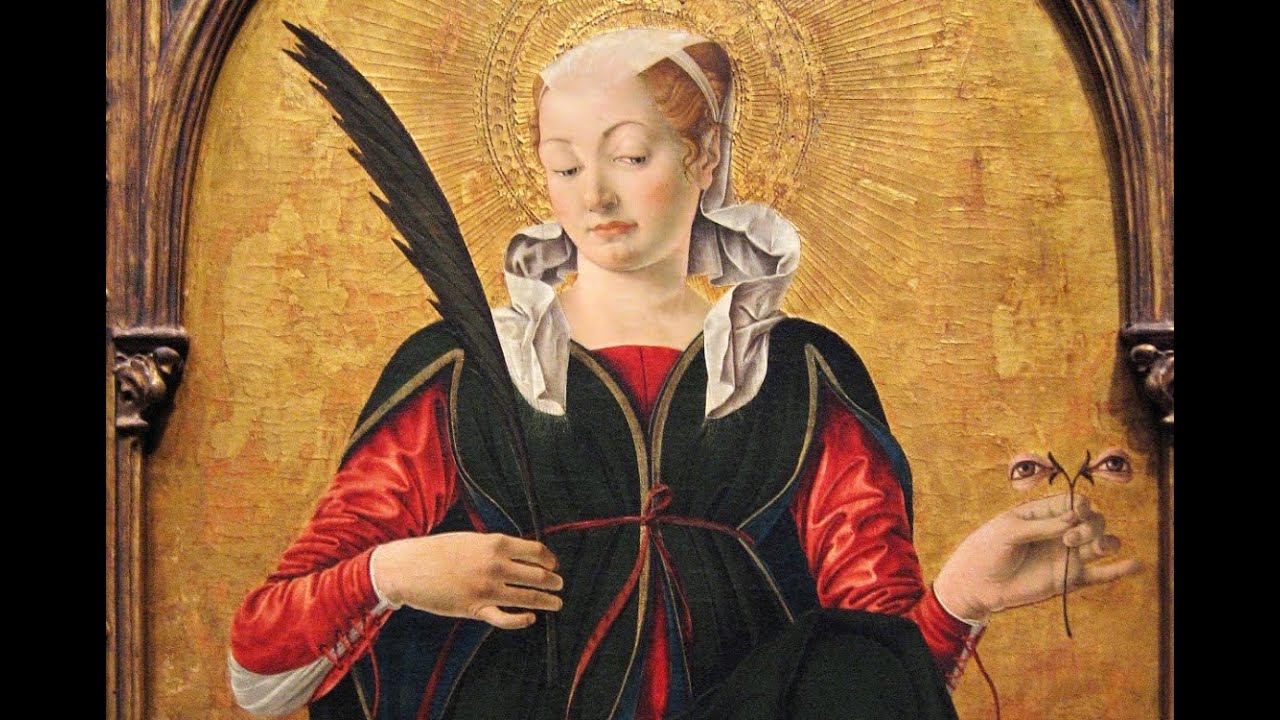
St. Lucia of Syracuse allegedly had her eyes gouged out before being martyred
Saints are looked to as role models and our siblings in Christ; inspiration for us to overcome our struggles and to help us through troubling times. While, ideally, Christ is the ultimate role model, Christians believe he lived a sinless life as one of three persons of the Triune God. Sometimes it’s hard to identify with a perfect person. Saints, unlike God, are not perfect in any way. Many were known sinners (St. Augustine of Hippo) or even put to death by members of the Church (St. Joan of Arc). They, like us, are humans born into original sin. Their virtue comes from Christ. They, like us, were imperfect but sought justice, love, and goodness. One day we may be saints too.
Makes sense? Great! So let’s break down what it means when people say Catholics “worship the saints”.
The word worship (from the Saxon weorthscipe) means [to give] honour. The term has never been exclusively used for devotion to a deity. Certain elected officials within the Commonwealth of Nations, particularly Lord Mayors, are addressed as “Your Worship“, similar to the address “Your Honour” we give in the United States to justices of the peace or the style “the Honourable” for various government officeholders. Throughout history and into modern day, monarchs, religious leaders, government officials and members of the nobility are worshiped in this way (Your Holiness, Your Eminence, Your Majesty, Your Highness, Your Grace, Your Excellency, Your Lordship/Ladyship)
Worship in a spiritual sense is divided into three types: Latria, Dulia, and Hyperdulia.
Latria, from classical Greek, meaning “the state of a hired servant”, is the first form of Christian worship. It was originally used to honor the Greek gods but also those dedicated to their service. With the Christianization of Europe, this term eventually became equated with Adoration, or worship and supreme honour to God alone. It had been used interchangeably to refer to servants of God (saints and angels), but a distinction was made by St. Augustine of Hippo between worship of God and honour given to saints and angels. (City of God X.1) Therefore, Latria is an act offered to God acknowledging His supremacy, perfection, dominion, and our dependence upon Him. Catholics perform this type of worship by celebrating the Mass, receiving the Sacraments, performing selfless acts of charity, fasting, practicing private devotions, and in Eucharistic Adoration.
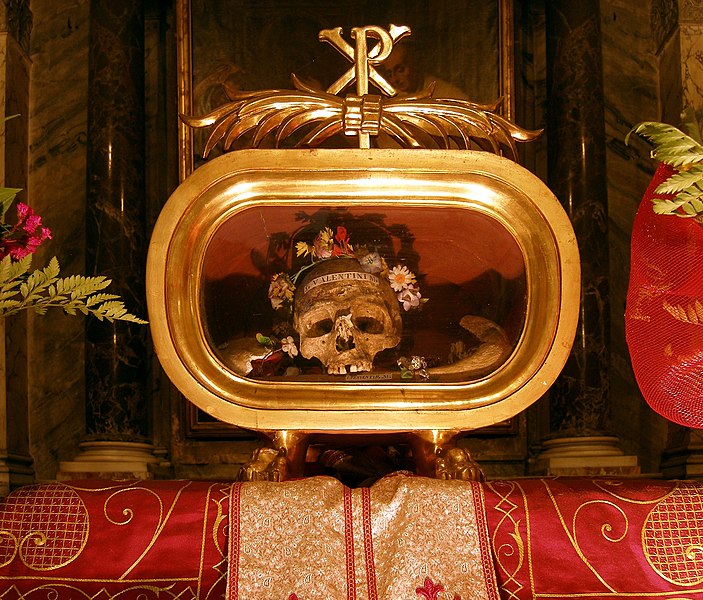
Dulia, the second form of Christian worship, is honour paid to the saints and angels. Through Dulia, Catholics honour the saints for their devotion to God, acts of charity, suffering, and personal sacrifice. Dulia includes veneration and invocation. Veneration (which can be given to saints themselves or objects associated with them (icons and relics) is the praise and admiration of a saint for their holiness. Invocation is the petition to a saint for their help. Catholics pray to the saints, but not in the way we pray to God in adoration. We believe in the Communion of Saints – that is- those on earth are united with souls in purgatory and in Heaven through our baptism and the grace of God. While we pray for our brothers and sisters on earth, we also pray for those suffering in purgatory, and ask that those in Heaven (who are freed from worldly torment and temptation, and are closer to God) may also pray for us. We do not believe that saints grant miracles on their own merit. Everything a saint does comes from God. For example, if you are ill you may pray to St. Raphael the Archangel for God’s healing; if you have lost something you may pray to St. Anthony for help finding it; if you are a parent struggling, you may pray to St. Monica for guidance. The saints then, in turn, make prayers and requests on your behalf to God. Veneration is then paid in return when these petitions have been granted. Veneration may take the form of prayers or offerings of flowers and candles before a statue or icon of the saint. In the Litany of the Saints Catholics ask individual saints by name to “pray for us.” To put it simply, we are connected by God’s amazing grace.
Biblical arguments for saintly and angelic intercession have been made from various passages including Jesus’ warning not to offend small children because their guardian angels intercede on their behalf to God in Matthew 18:10, the Rich Man’s plea to Abraham to send a messenger to his brother’s house in order to warn him of suffering in the afterlife in Luke 16:19-31, the elders falling down before the Lamb of God holding bowls of prayers in the forms of incense in Revelation 5:8, and the angel presenting prayers upon the golden altar before God in Revelation 8:3-4.
Hyperdulia, the third form of Christian worship, is honour and devotion to the Blessed Virgin Mary, whom Catholics venerate as the Mother of God, Mother of All Christians, Queen of Heaven, and Mediatrix of All Graces. Mary, a human and not divine, was chosen by God to be the bearer of God. She differs from other saints in that we believe she was sinless, but not by her own merit. We believe she was Immaculately Conceived (meaning upon her conception God prevented the stain of original sin from reaching her) so that Christ could be borne from her womb. We believe that she was a Perpetual Virgin whom virginally conceived Christ and, at the end of her life, was assumed body and soul into Heaven. As such, she is venerated in a higher degree than the other saints but is not adored like God. We invoke her protection and intercession through popular devotions like the rosary. One of the most popular prayers of the rosary is the Hail Mary, which ends with:
“Holy Mary, Mother of God, Pray for us sinners now and at the hour of our death.”
Even our love and devotion to Mary is Christ-centered. I once read a poem that depicted Mary as the Moon and Christ as the Sun. We admire the moon for it’s beautiful light that shines in the darkness, but the moon’s light is not its own. It’s a mirror of the sun, reflecting the light. So we see Mary as a reflection of Christ’s love for us.

His Holiness Pope Francis gesturing toward a statue of Our Lady of Fátima during her feast day celebration in St. Peter’s Square
In the House of David, the Queen was not a wife of the King. The Queen was the mother of the King (Bathsheba was Solomon’s mother and Queen, Naamah was Rehoboam’s mother and queen, Maacah, was the mother and queen of Abijah and grandmother and queen of Asa). Since Jesus is from the House of David, we view his divine kingship as Davidic, and therefore Mary is Queen. In this way we honour her and ask for her love, protection, and intercession not as a saviour but as the Mother of Our Saviour.
Because of her role as an intercessor to Christ, we believe she has appeared to people all over the world throughout the course of history to deliver important messages from God. Believing in Marian apparitions is not a requirement of the Catholic faith, but most Catholics accept the apparitions. While there have been hundreds of reported apparitions that are supported by local dioceses, the Vatican has only officially declared Our Lady of Guadalupe, Our Lady of Lourdes, Our Lady of Fátima, Our Lady of the Miraculous Medal, Our Lady of Laus, Our Lady of La Salette, Our Lady of Pontmain, Our Lady of Beauraing, and Our Lady of Banneux as worthy of belief. Although not given papal recognition in this way other alleged apparitions (Our Lady of Knock, Our Lady of Walsingham, Our Lady of Medjugorje) are often widely accepted as worthy of veneration.
WHOOO! I know that was a lot of reading. I hope I’ve clarified some misunderstandings that Catholics and non-Catholics alike have had about saints, prayer, and worship in the Catholic faith. My goal here is to help Catholics express their faith, non-Catholics to understand our point-of-view, and for all of us to realize how much we actually have in common. Dialogue – it’s important y’all. ‘Till next time!
ab imo pectore,
Will




 Living my life at a Derby party


